
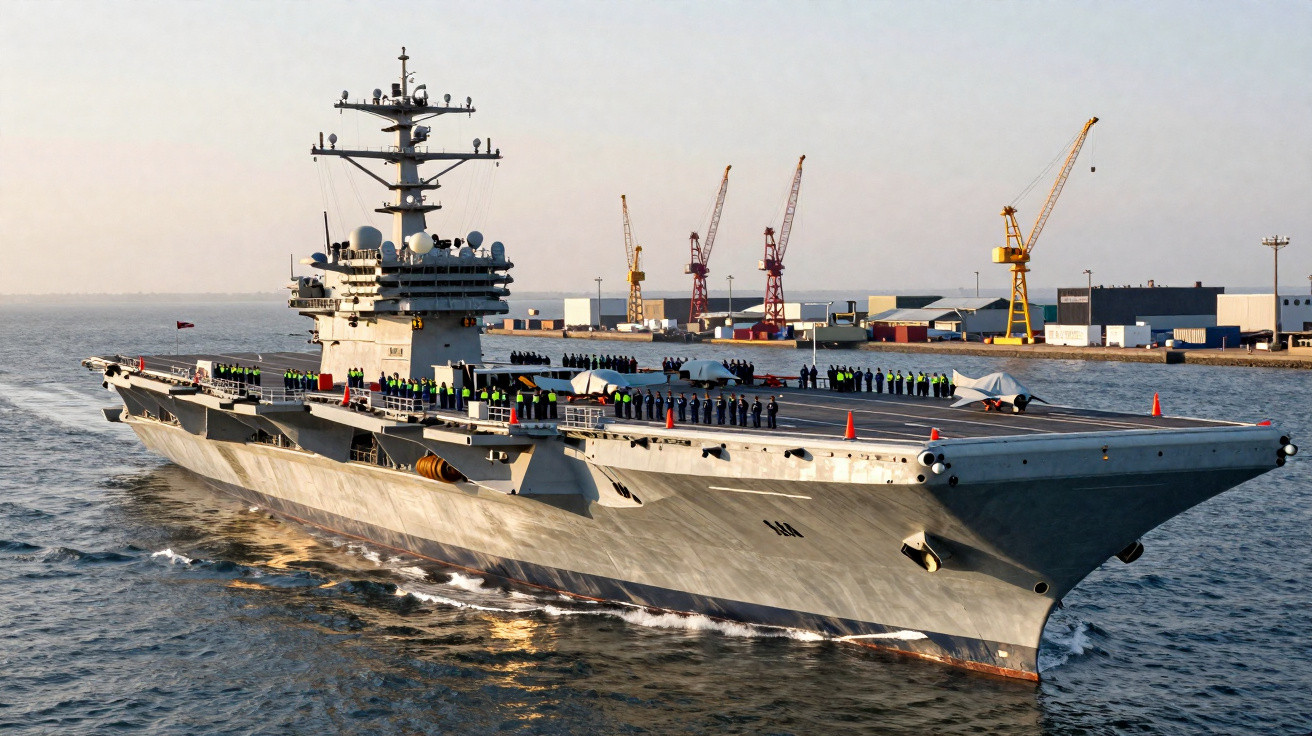
After years of building work and preparation at the Newport News shipyard, the second nuclear-powered aircraft carrier in the new Gerald R. Ford class has reached an important milestone on its route to delivery to the United States Navy (U.S. Navy). Yesterday, the future USS John F. Kennedy (CVN-79) left Newport News Shipbuilding’s Virginia facilities for the first time to begin its initial sea and navigation trials, a long-awaited development in the programme to replace the existing Nimitz-class aircraft carriers.
USS John F. Kennedy begins builder’s sea trials
The milestone, first reported by several specialist outlets, was subsequently confirmed by Huntington Ingalls Industries (HII) on its social media channels. HII stated that the future CVN-79 had departed the yard to commence the “builder’s sea trials”, the opening stage designed to assess the nuclear aircraft carrier’s principal systems, equipment and components at sea for the first time.
An essential initial evaluation
The trials will check vital systems including the nuclear propulsion plant, electrical power-generation systems, navigation, ship handling and platform control, ahead of more demanding stages later in the process. It is a phased programme: the aircraft carrier John F. Kennedy will complete a series of sorties and technical assessments before its formal handover to the U.S. Navy for acceptance trials and the eventual integration of its embarked air wing.
HII stressed that this first period underway opens a new chapter in the construction of CVN-79, shifting attention from the controlled conditions of the shipyard to the practical validation of its capabilities in operational conditions.
A programme refined through adjustments
USS John F. Kennedy’s sea trials begin following a lengthy period of final work, refinements and delays, partly associated with lessons learned from the first ship in the class, USS Gerald R. Ford (CVN-78). Compared with the Nimitz-class carriers, the new class brings substantial changes, including EMALS electromagnetic catapults, the AAG recovery system, a redesigned island and a new electrical architecture.
Although these advances are intended to boost operational efficiency and lower costs across the ship’s service life, their initial integration created technical difficulties involving systems and technology, affecting testing timetables. For CVN-79, many of those systems have been fitted with modifications and upgrades informed by earlier experience, which should ease the certification and acceptance process.
John F. Kennedy’s place in the future U.S. Navy fleet
After completing the various testing and certification stages, USS John F. Kennedy will become the second operational aircraft carrier of the Gerald R. Ford class, which is intended to provide the backbone of the U.S. Navy for decades to come. The new vessel is also expected to be ready to operate fifth-generation F-35C Joint Strike Fighter Lightning II aircraft and the new Enterprise air-surveillance radar.
With its first departure to sea, John F. Kennedy has begun a process which, following additional trials and assessments, will see it fully join the U.S. surface fleet. Unless circumstances change, the aircraft carrier is due to be delivered to the U.S. Navy in March 2027, replacing the carrier Nimitz (CVN-68), which has started its retirement process after more than fifty years of service.
You may also like: The U.S. Air Force and Northrop Grumman finalise details to expand production of the new B-21 Raider stealth bombers




Comments
No comments yet. Be the first to comment!
Leave a Comment