
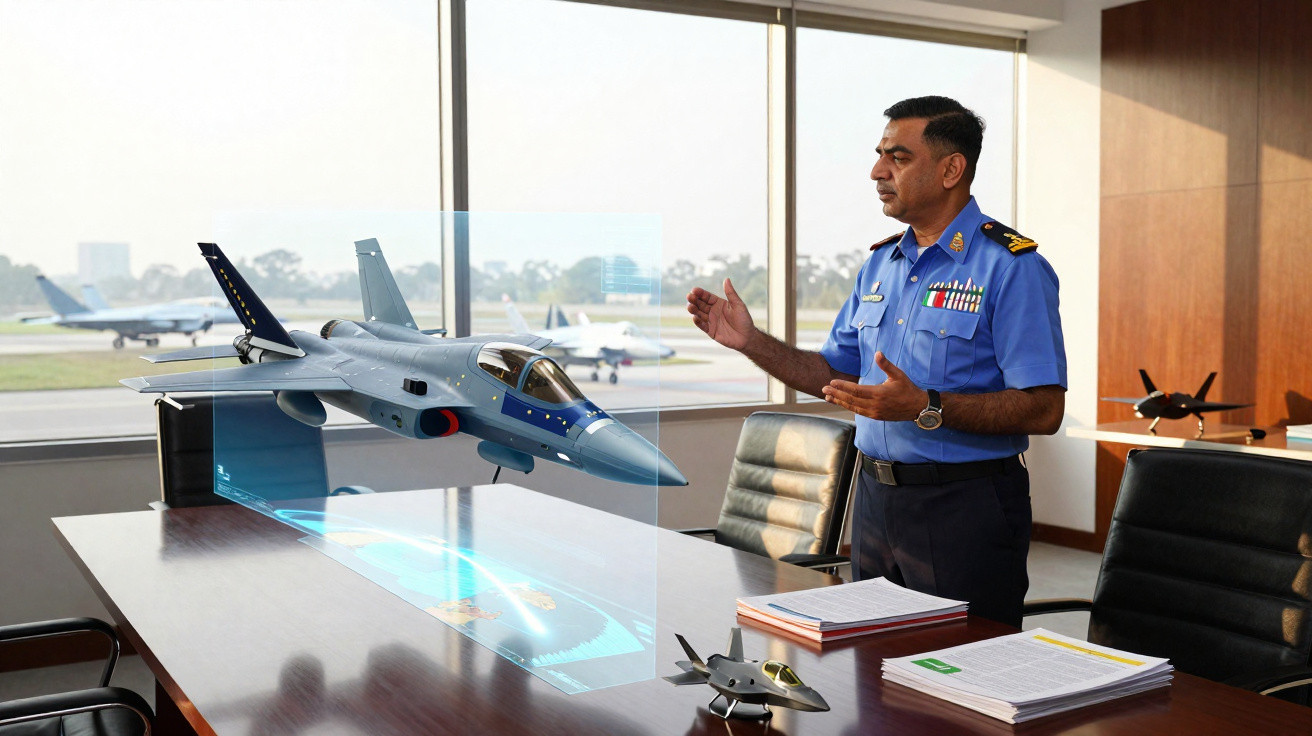
In a presentation to Parliament’s Standing Committee on Defence, India’s Ministry of Defence indicated that it is assessing the option of joining one of Europe’s sixth-generation fighter programmes. The only two programmes currently available are FCAS and GCAP. Official documentation states that such a move would address the urgent need to modernise the country’s Air Force combat capabilities, while stressing that air superiority is of paramount importance in modern warfare.
One section of the document states: “The Committee has been informed that two consortia are working on sixth-generation aircraft. One is a consortium of the United Kingdom, Italy and Japan (Ed.: the GCAP programme), while the other is a consortium of France, Spain and Germany (Ed.: the FCAS programme), and both are developing aircraft. The Committee has also been informed that the Air Force will seek to join forces with one of the consortia and will immediately begin considering a sixth-generation fighter, in order to ensure that it does not fall behind in achieving the objective of advanced aircraft.”
India’s options: GCAP and FCAS
At present, only the GCAP programme appears to be progressing in line with its planned timetable. This remains the case despite accusations from Italy that the United Kingdom was not sharing key technologies required for the development of the new sixth-generation fighter, although the specific components involved were not identified at the time. Under the current schedule, the platform is expected to enter service in the middle of the next decade. At first glance, this appears to be a realistic target and would leave room for India potentially to join the programme.
The main question is whether New Delhi would actually be accepted as a programme partner, as this is by no means assured. Saudi Arabia’s candidacy was also considered by the consortium partners, encouraged by Italy, but it ultimately did not materialise. More recently, Leonardo’s current chief executive, Roberto Cingolani, said he was “more than open” to that prospect and, given the scale of the undertaking, that “having more partners would be perfect”.
The outlook is less encouraging for the alternative, the FCAS programme, given the well-known major disputes between the German and French sides. These stem from allegations that Dassault is seeking to secure the largest share of the development work, a claim the company denies. The situation has become so serious that there has repeatedly been speculation about Berlin withdrawing from the programme and Paris having to pursue the project alone, recalling the earlier development of the Rafale fighter.
For India, such an outcome could create a potential route into the programme. Its close links with the French defence industry could help give fresh momentum to the FCAS programme, which has so far been held back. From France’s perspective, it could also be assumed that New Delhi would not seek an equal role in the project, which might at least initially resolve the issues outlined above. Furthermore, the two countries already have an established foundation for technology transfer, which could make it easier to combine their respective industrial capabilities.
What about fifth-generation fighters?
Alongside this development, India has also spent years pursuing a fifth-generation aircraft to bring its capabilities closer to those of neighbouring China and other powers around the world. More specifically, the country is developing its indigenous fighter, known as AMCA, while also considering the acquisition of US-built F-35s and Russian Su-57s.
The same document cited above states: “The Advanced Medium Combat Aircraft (AMCA) is under development, and discussions on its design and manufacture are currently underway.” However, although the Indian government approved the construction of a prototype in May 2025, the programme is still thought to be at an early stage and has shown little major progress in recent months. One of the few notable developments has been the selection of Safran to develop the future engines for the platform, which should be capable of producing between 110 and 120 kN.
When considering the other two platforms, Indian analysts appear to agree that the Su-57 has the strongest prospects of securing a place in the Indian Air Force. This is particularly due to the willingness to involve local industry through production proposals aligned with the “Made in India” policy, a key consideration in the country’s procurement decisions in recent years. It should also be noted that United Aircraft Corporation (UAC) has already said it would be willing to support development of the AMCA fighter should New Delhi choose the Su-57, while also making use of facilities previously employed to manufacture Su-30MKIs.
Images used for illustrative purposes.



Comments
No comments yet. Be the first to comment!
Leave a Comment