
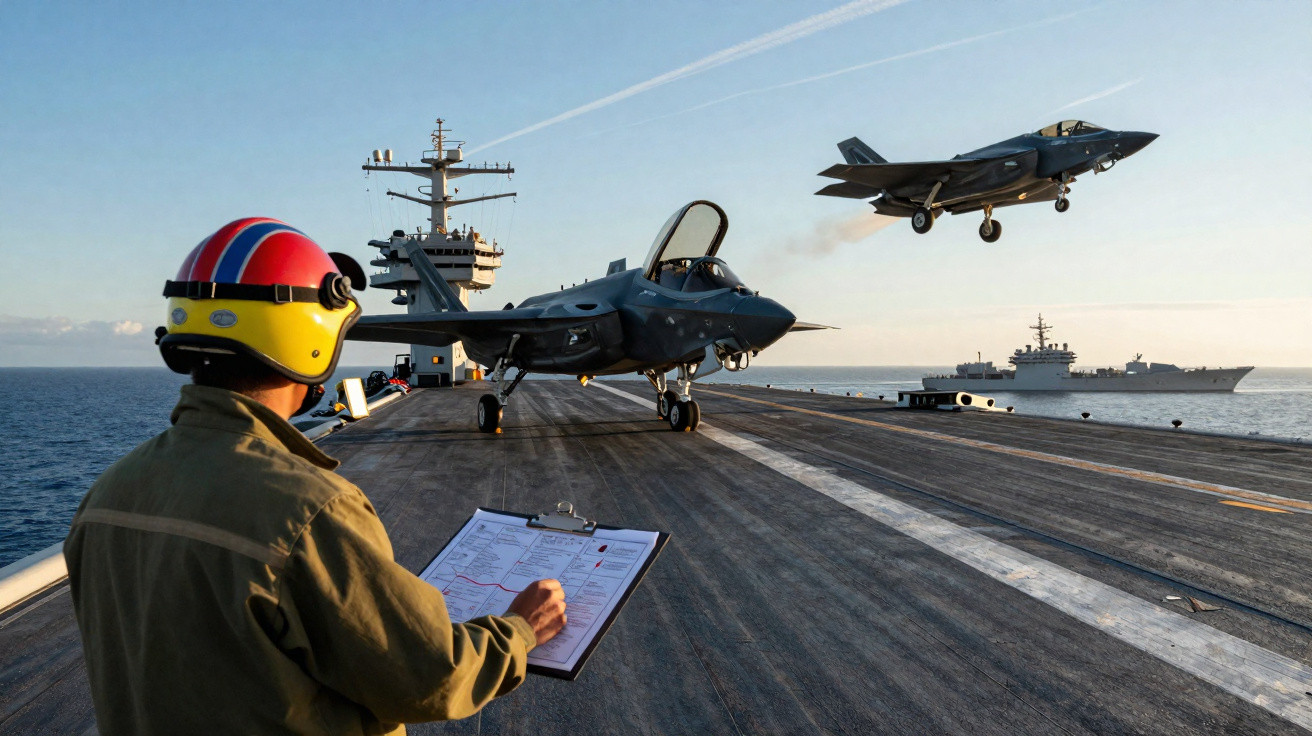
On satellite imagery, ships resemble tiny grey toys scattered across a deep-blue expanse. Yet standing on the rolling deck of an American carrier in the western Pacific would make the scene feel enormous. Jet exhaust tugs at your clothing. Deck crews work with tightly choreographed speed. An F-35, difficult to detect, inches towards the catapult as its pilot looks out across waters China increasingly treats as its own.
Beyond the horizon, air bases on Hainan and the expanding Chinese Navy fleet form a quiet, observant presence.
Here, the divide between an exercise and a warning can be exceptionally narrow.
The day carriers appeared on China’s doorstep
It began as one radar return, followed by another, then a mass of contacts.
On Chinese tracking displays, a U.S. carrier strike group emerged near the South China Sea. A second followed, with missile-armed destroyers and cruisers accompanying them. On the flight decks, F-35C stealth fighters and F/A-18s waited beneath the morning sun, their folded wings resembling resting birds.
This was not an inconspicuous passage. It was a display of military strength positioned where Beijing least welcomes it.
A U.S. Navy photographer recently recorded an image that conveyed the situation more clearly than any official statement. Two vast carriers - USS Carl Vinson and USS Theodore Roosevelt - sailed together through the Philippine Sea, with their escorts alongside. Above them, F-35s and F-18s thundered skywards in close formation, as though jet trails had sketched a no-fly warning across the sky.
To those viewing from shore, or later scrolling through the images, the scene recalled Cold War demonstrations of power. The difference was that these coordinates lay uncomfortably near Taiwan and the artificial islands China has developed into fortified bases.
Washington describes such deployments as “routine operations” and “freedom of navigation”. Beijing brands them provocations.
Strategically, this is the U.S. Navy’s preferred form of communication: presence. Place a carrier within aircraft range of disputed territory and little needs to be said. The F-35s make the point. Their capacity to penetrate dense air defences and distribute targeting information makes Chinese planners reconsider their options repeatedly.
That is how deterrence functions in practice: less a cinematic confrontation than two chess players leaning slightly too far across the same board.
How F-35s make steel decks into floating warning signs
On paper, a U.S. carrier strike group is simply a collection of vessel names and specifications. Seen close-up, it is a layered system.
At its core sits the carrier, a floating airfield roughly the scale of a city block. It is surrounded by destroyers and cruisers prepared to detect submarines, intercept missiles and return fire. Overhead, F-35s and other aircraft create an unseen mesh of radar coverage and data links extending hundreds of kilometres towards China’s coastline.
The essential point is that its strength lies not solely in the equipment, but in how every component communicates with the others.
Many people view the F-35 as “just another stealth fighter”. That overlooks its more unusual and troubling role. The aircraft also acts as an airborne sensor sponge, collecting radar emissions, radio traffic and electronic signals before passing them to ships and other aircraft in near real time.
When carriers operate near the South China Sea or off Taiwan, every F-35 sortie turns the sea into a moving surveillance network. This is what quietly concerns Chinese planners: not only the aircraft themselves, but their ability to make every nearby American ship more effective at targeting.
Most people recognise the discomfort of suddenly realising the other side has been observing all along.
Chinese officials speak forcefully in public, labelling the U.S. presence a “serious threat to regional peace.” Behind closed doors, however, their generals must account for an awkward fact: one carrier air wing now combines stealth aircraft, electronic-warfare aircraft and drones capable of complicating any attempt to take Taiwan or force the U.S. Navy beyond the first island chain.
In truth, few believe either side wants to fire first. The contest is about appearing more prepared without overturning the board.
Reading the signals when warships operate this close
To interpret what such a deployment means, begin with distance and duration.
Did the carriers transit rapidly or remain in the area? Did they sail off Taiwan’s east coast, through the Luzon Strait or nearer the Spratly Islands? Every route forms its own sentence in the language of strategy, with F-35s serving as exclamation marks.
Following patterns over time - the vessels, aircraft and exercises involved - provides the nearest equivalent to subtitles for this high-stakes drama.
The simplest error is to treat every movement as a countdown to conflict. That is social media’s instinct, and panic attracts attention.
A more realistic reading is less dramatic but more disturbing. The United States and China continually practise for the worst day that both hope will never arrive. Live-fire exercises, simulated missile attacks and intercepts in confined airspace are the “muscle memory” drills of modern armed forces.
The emotional response is predictable: images of three nuclear-powered carriers and a mass of stealth fighters in “China’s backyard” make the mind leap to catastrophe rather than choreography.
The plain-truth nobody likes to admit is that much of modern deterrence is theater - extremely dangerous, heavily armed theater, but theater all the same.
When U.S. carriers arrive, Chinese aircraft scramble, Chinese ships shadow them, and radios carry brief, carefully prepared warnings. Both sides are performing for one another, as well as for domestic audiences following events through headlines.
To assess these episodes without losing perspective, keep a short checklist in mind:
- Who moved first, and did they remain or merely pass through?
- Did the deployment follow a crisis, an election or a new law?
- Did it involve live-fire exercises, or only fly-pasts and formation photographs?
- Did either side alter its language afterwards - becoming softer or markedly louder?
- Are civilian flights being rerouted, or are trade routes genuinely being disrupted?
Living beneath a sky full of messages
There is an odd contrast between a quiet morning in Taipei, Manila or Okinawa and the vast array of military hardware moving over the surrounding seas. Most people are simply commuting, buying coffee or replying to messages. Beyond the horizon, out of sight, an F-35 pilot may be joining formation during a carrier approach or locking onto a “hostile” radar contact in a training scenario designed to closely resemble China.
These two realities continue side by side. They rarely meet, yet remain uncomfortably close.
Perhaps the real burden of this story is not that the U.S. Navy deployed carriers and stealth fighters in China’s backyard, but that such an action now appears almost routine.
Each deployment establishes a baseline for the next. Every close interception and every carrier deck filled with noise shifts the dial slightly nearer to “normal”. Eventually, both sides may lose sight of how abnormal it is for so much firepower to linger in the same sea while interpreting each other’s actions in real time.
The unresolved question is both straightforward and difficult: how many more of these “messages” can the region take before somebody misunderstands the script?
| Key point | Detail | Value for the reader |
|---|---|---|
| Carriers as signals | U.S. carrier strike groups operate near China to project power and reassure allies | Helps interpret headlines about naval movements without immediately assuming panic is warranted |
| F-35 as sensor hub | Stealth jets connect ships and aircraft into one large information network | Explains why these deployments concern Chinese planners beyond simply meaning “more planes” |
| Deterrence as theater | Both sides conduct heavily armed “shows” to shape perceptions and avoid appearing weak | Provides a mental filter for distinguishing genuine escalation from strategic messaging |
FAQ:
- Question 1 Are U.S. carriers actually entering Chinese territorial waters?
- Answer 1 No. They normally operate in international waters, including the South China Sea and Philippine Sea, at times within areas China calls its “near seas”, but beyond the 12-nautical-mile boundary that defines territorial waters under international law.
- Question 2 Why does the U.S. send F-35s so close to China?
- Answer 2 The U.S. says this concerns “freedom of navigation” and support for allies including Japan, South Korea and the Philippines. Strategically, it also tests Chinese defences, collects data and signals that any action against Taiwan or critical sea lanes would face a rapid, high-technology response.
- Question 3 Could a small incident around these carriers start a larger war?
- Answer 3




Comments
No comments yet. Be the first to comment!
Leave a Comment