
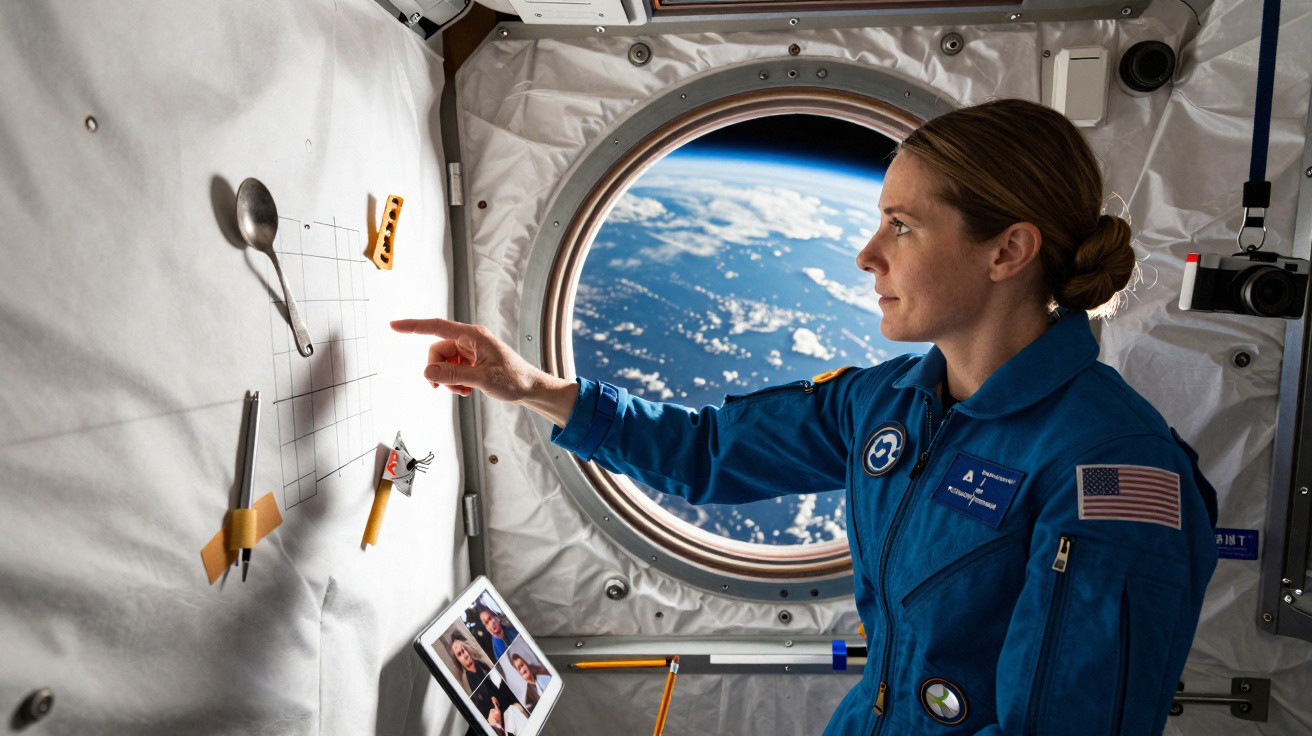
New findings from the first archaeological field study undertaken in space reveal that the International Space Station is a complex cultural landscape. Its crew members create their own "gravity" as a substitute for Earth’s and reshape module areas to meet everyday requirements.
Archaeology is commonly associated with the remote past, yet it is particularly well placed to show how people adjust to extended periods of spaceflight.
For the SQuARE experiment, set out in our new PLOS ONE paper, we adapted a conventional archaeological approach for space and asked astronauts to undertake it on our behalf.
Archaeology … in … spaaaaace!
The International Space Station is humanity’s first permanent settlement beyond Earth. Nearly 280 people have visited it over the past 23 years.
Our research team has examined displays of photographs, religious icons and art created by crew from different nations. We have also monitored cargo returned to Earth and drawn on NASA’s historical photograph archive to investigate the relationships between crew members serving together.
We have studied straightforward technologies too, including Velcro and resealable plastic bags. Astronauts use these to reproduce gravity’s Earthly effect in microgravity: keeping belongings where they were put rather than allowing them to float away.
More recently, we gathered information about the way crew members used objects inside the station by modifying one of archaeology’s most established methods: the "shovel test pit".
Once an archaeological site on Earth has been identified, researchers mark out a grid of one-metre squares and excavate selected squares as "test pits". Together, these samples provide an impression of the wider site.
In January 2022, we asked the space station crew to establish five approximately square sampling areas. We selected locations covering work, science, exercise and leisure zones. The crew chose a sixth location themselves, based on what they considered might be worthwhile to observe. The International Space Station National Laboratory sponsored the study.
For the following 60 days, crew members took a photograph of every square each day, recording the objects contained within its limits. As everything in space culture has an acronym, we named the activity the Sampling Quadrangle Assemblages Research Experiment, or SQuARE.
These images reveal the International Space Station’s rich cultural landscape, while making clear how unlike science-fiction fantasies life in space really is.
The station is cramped, cluttered, untidy and chaotic. There are no divisions between the areas where crew work and those where they relax. Privacy is minimal or absent. There is not even a shower.
What we found in the squares
We can now report the analysis of the first two squares. One was in the US Node 2 module, which contains four crew berths and links to the European and Japanese laboratories. Visiting spacecraft frequently dock at this point.
We focused on a wall containing the Maintenance Work Area, or MWA. It has a blue metal panel fitted with 40 Velcro squares, with a table beneath it for repairing equipment or carrying out experiments.
NASA designed this area for maintenance. Yet we found very little sign of maintenance work and only a small number of scientific activities. Indeed, on 50 of the 60 days surveyed, the square served solely as storage for items that may not even have been used in that location.
The large quantity of Velcro made this an ideal spot for improvised storage. Nearly half of all recorded objects (44%) related to securing other objects in place.
The second completed square was in the US Node 3 module, home to exercise equipment and the toilet. It also forms a route to the crew’s preferred section of the station, the seven-sided cupola window, as well as to storage modules.
Because this wall had no assigned purpose, it was put to mixed uses: holding a laptop, an antibacterial experiment and resealable bags. For 52 days of SQuARE, it was also where one crew member stored their toiletry kit.
Keeping toiletries close to the toilet and the exercise machines, which every astronaut uses for hours daily, has a certain logic. However, this is a very public area through which other people continually pass. The toiletry kit’s position demonstrates how insufficient the facilities are for hygiene and privacy.
What does this mean?
Our examination of Squares 03 and 05 showed how restraints such as Velcro generate a form of temporary gravity.
Restraints holding an object in place create a patch of active gravity, whereas unused restraints indicate potential gravity. Analysing the artefacts allows us to assess how much potential gravity is available in each place.
Scientific work is the International Space Station’s principal purpose. Achieving it requires astronauts to deploy many objects. Square 03 illustrates how they transformed a surface intended for maintenance into a halfway house for assorted items moving around the station.
Our evidence indicates that those designing future space stations - including commercial stations now planned for low Earth orbit and the Gateway station under construction for lunar orbit - may need to give storage greater priority.
Square 05 demonstrates how an unidentified crew member appropriated a public wall for personal storage. We already know that privacy provision is less than ideal, but the toiletry bag’s continued presence there shows how crew members modify spaces to compensate.
Our conclusions matter because they are grounded in evidence. The first two squares indicate that data from all six will provide additional insights into humanity’s longest-lasting space habitat.
The current plan is to deorbit the space station in 2031, meaning this experiment may be our only opportunity to collect archaeological data.
The authors gratefully acknowledge the work of our collaborators Shawn Graham, Chantal Brousseau, and Salma Abdullah.
Justin St. P. Walsh, Professor of art history, archaeology, and space studies, Chapman University and Alice Gorman, Associate Professor in Archaeology and Space Studies, Flinders University
This article is republished from The Conversation under a Creative Commons license. Read the original article.

Comments
No comments yet. Be the first to comment!
Leave a Comment