
Climate scientists have spent years modelling a slowdown in the Atlantic current, with the findings consistently indicating the same outcome.
Deep waters around Antarctica were also expected to react, although forecasts alone cannot demonstrate that this has happened.
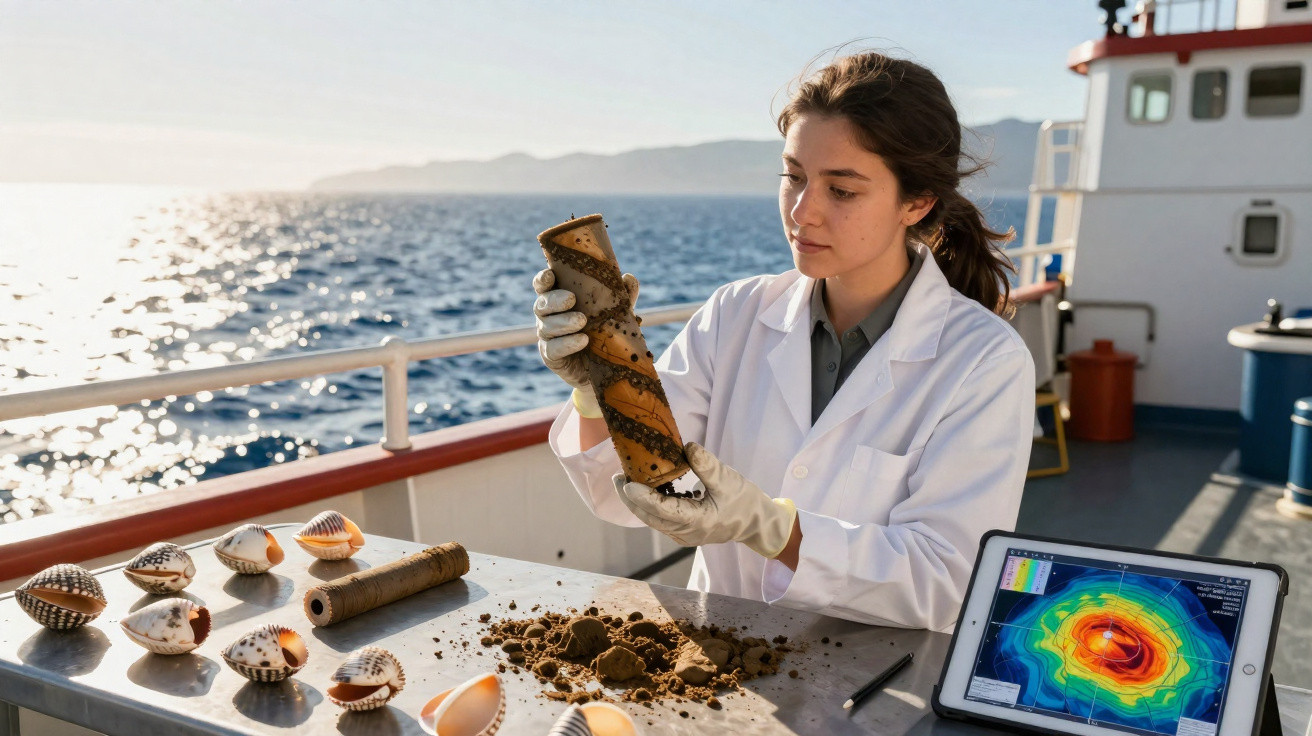
A research group studying sediment cores collected off Chile’s coast has now uncovered supporting evidence.
Chemical traces preserved in shells smaller than a grain of sand indicate that the anticipated response occurred swiftly 39,400 years ago.
Evidence from ancient shells
Pushpak Martin John Nadar, a palaeoclimate scientist at the University of Bergen (UiB) in Norway, headed the research team.
The researchers examined chemical signatures held within minuscule shells from seabed microorganisms known as foraminifera. These shells form from the surrounding water.
Carbon and oxygen isotopes are subtly different versions of the same chemical elements.
As these isotopes are retained in the shells, they enable scientists to track deep water from many tens of thousands of years in the past.
The sediment core was obtained off Chile, at a location where Southern Ocean currents flow northwards into the Pacific.
The period examined centres on about 39,400 years ago. Greenland ice cores indicate that the North Atlantic became exceptionally cold at that time and that its circulation was probably weaker.
How the Atlantic Meridional Overturning Circulation slows
This circulation system is known as the Atlantic Meridional Overturning Circulation (AMOC).
Warm, salty water at the surface travels northwards, gives off heat to the atmosphere, sinks and subsequently flows south at depth. Without this process, the planet’s distribution of heat would be very different.
A weaker circulation has consequences beyond the North Atlantic. Climate models suggest that a reduced AMOC redistributes heat and nutrients throughout the global ocean in unexpected patterns.
Recent measurements show that a decline is already in progress. Nadar’s team investigated whether ancient sediments contained direct physical evidence of such changes extending far beyond the Atlantic.
If so, the current slowing of the AMOC may already be altering ocean chemistry well outside the Atlantic basin.
A Pacific signal
The cores contained a striking record. At around 39,400 years ago, deep water off Chile warmed rapidly, oxygen concentrations rose markedly and carbon isotopes increased.
All three shifts occurred together. This degree of synchronisation is unusual in palaeoclimate records, where changes more commonly develop slowly.
Taken together, the measurements point to water that had recently been at the ocean surface.
Marine scientists refer to this as increased ventilation: water had recently been in contact with the atmosphere, gaining oxygen and losing nutrients.
The water body involved is Antarctic Intermediate Water, which forms near Antarctica and moves towards the tropics at roughly 800 metres beneath the surface.
Before this research, its reaction to a slowdown in Atlantic circulation had not been linked with such precision.
The chemical response
A pronounced increase in oxygen was particularly notable. Such a rise occurs when water that has recently reached the surface arrives at depth.
The carbon isotopes supported this conclusion. Their signature corresponded with newly circulated water, rather than the depleted chemical signal associated with stagnant deep water.
The modest warming of bottom water also agreed with climate-model projections for a slowing AMOC.
Heat that would usually be carried northwards may instead have built up in the Southern Hemisphere, introducing additional warmth into the intermediate layer.
Nutrient levels in this layer fell as well. That reduction probably reflects a broader reorganisation of biological fuel in mid-depth waters, supplying distant surface ecosystems.
This explanation is consistent with previous research identifying the Southern Ocean as the deep ocean’s greatest source of oxygen.
Warmer layers at greater depth
Across model simulations, a weaker AMOC causes the thermocline - the dividing line between warm surface water and cold deep water - to move downwards in the Pacific.
Northward transport of heat weakens, while warmth instead accumulates south of the equator. Nadar’s findings provide real-world evidence consistent with that forecast.
The chemical patterns in the Chilean sediment cores are precisely what would be expected if the thermocline deepened and the layer immediately beneath the surface drew in younger water influenced by surface conditions.
This kind of confirmation is uncommon in palaeoclimate research. Models may project a particular result, but sediment archives seldom verify it directly.
Comparing the models with the sediment evidence improves understanding of how the global ocean reacts when one part of its circulation system slows.
The missing part of the carbon story
Ice cores reveal that carbon dioxide increased during these ancient Atlantic slowdowns, and researchers have debated the reason for decades.
Some explanations focus on deep Pacific waters, while others centre on Southern Ocean upwelling close to Antarctica.
The latest results reduce the range of possibilities. If intermediate water was ventilating more intensely at the time, stored carbon may have moved into shallower layers, where it can exchange with the atmosphere.
Earlier studies of Antarctic bottom waters point to a related contribution. This evidence does not resolve the CO2 question by itself.
However, it rules out some possible explanations and leaves a narrower group for future research to assess using further sediment records and climate simulations.
Implications for the future
The AMOC is currently weakening, and the same physical mechanisms operating 39,400 years ago are active once more.
If Antarctic intermediate waters respond now as they did then, oxygen, carbon and nutrient distributions across large areas of the ocean could change considerably.
For fisheries, these changes may influence productive regions off South America and Africa, where nutrients from intermediate depths support life at the surface.
For forecasting, models that overlook the Southern Hemisphere’s response to Atlantic changes will fail to capture part of the system.
The Bergen researchers have demonstrated that this connection is genuine, rapid and identifiable through chemistry. Scientists no longer need to rely on models alone to assume that Antarctic-to-Atlantic feedback occurs.
The sediment archive shows that this process happened in the past and could happen again.






Comments
No comments yet. Be the first to comment!
Leave a Comment