
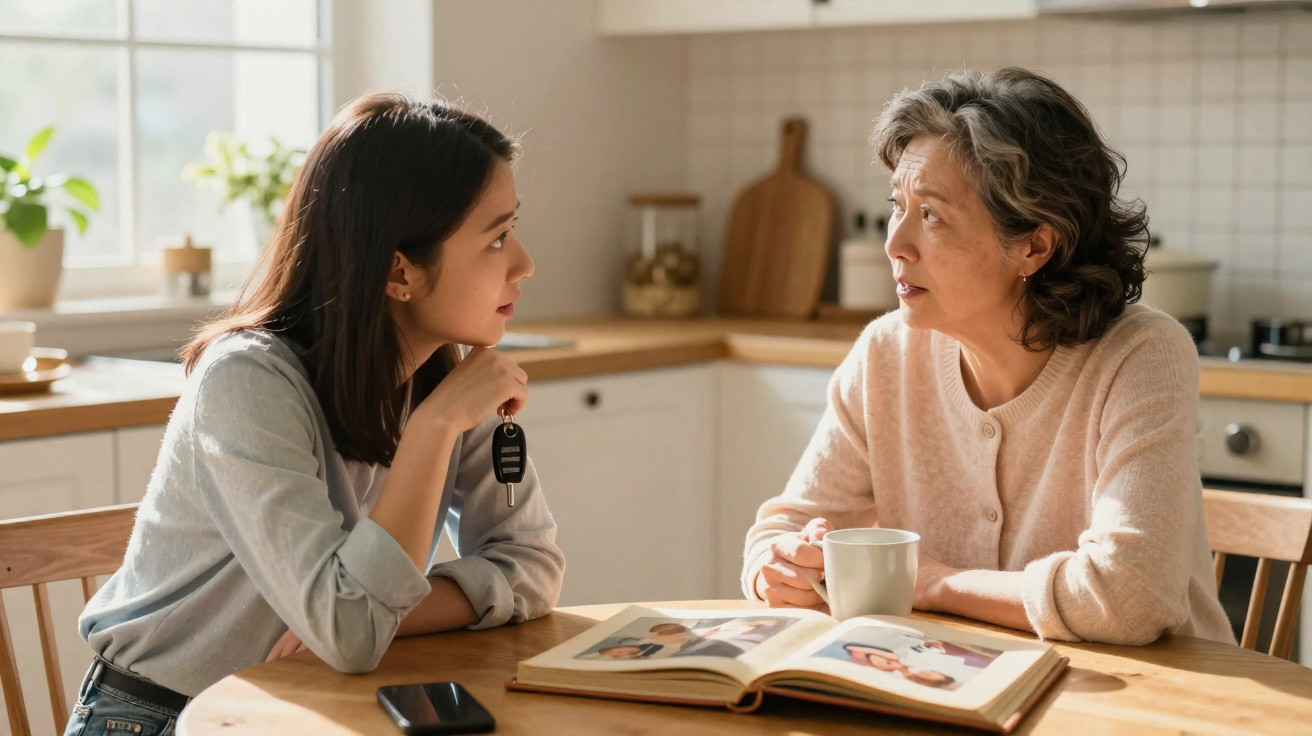
Many parents now in their thirties and forties are discovering that it is not their authoritarian grandparents who are most draining, but their well-meaning Boomer parents: the people who preached independence, yet now struggle with the real autonomy of their adult children.
When independence is acceptable only while everything remains familiar
In many Baby Boomer families, one message was everywhere: “Be strong, rely on yourself, make something of your life.” Dependence was viewed as weakness, while doing nothing was seen as a moral failure. Anyone who persevered was considered a “good” person.
The difficulty is that this independence was often quietly conditional. Choices were welcomed when they fitted a familiar model of life: a secure job, owning a home, a traditional family and a lifestyle resembling that of the parents.
Many children of Boomers learned to solve problems alone – but not how to deal with parents who continually question their solutions.
When adult children choose different paths today, friction follows: changing jobs, becoming self-employed, working part-time, choosing to live with less, alternative family arrangements or different parenting styles. Independence is fine – provided it still fits their parents’ worldview.
Quiet exhaustion: no drama, but constant pressure
The most tiring conflicts in these families are often understated. They rarely involve open blow-ups; instead, they come as small barbs wrapped in apparently harmless remarks:
- “Are you sure you can make a living from that?” (about changing career)
- “You were always so good at your old job.” (about leaving secure employment)
- “We managed perfectly well without organic food in the past; you’re overdoing it.” (about a more conscious lifestyle)
- “Children need structure – that’s scientifically proven.” (about alternative forms of parenting)
Such comments do not sound like outright bans. Instead, they feel like an ongoing, low-level appraisal of performance. Every choice is put under scrutiny – by the very people who once encouraged self-reliance.
Why the Boomer generation so often stumbles
Looking back helps explain this tension. Many Boomers grew up with parents who were openly authoritarian: “As long as you put your feet under my table, you do as I say.” The boundaries were narrow, but unambiguous.
Boomers deliberately wanted to do things differently. They advocated thinking critically, not obeying blindly, taking opportunities and refusing to be boxed in. Yet many lacked the emotional tools needed to genuinely tolerate that freedom later on.
They wanted children who would follow their own path – but never learned how to remain alongside someone whose path looks completely different from their own.
In addition, many Boomer families worked themselves to exhaustion but seldom talked about feelings. Conflicts were swallowed rather than worked through. Closeness meant having a similar life, similar views and similar choices.
The hidden contradiction in the parenting brief
Ultimately, children receive an ambiguous set of instructions:
- Be independent – but in a way we can understand.
- Make your own decisions – but ones that do not unsettle us.
- Follow your own path – but stay as close as possible to ours.
For the adult-child generation, this can feel like a trap. Adapting means betraying themselves; acting consistently and independently brings their parents’ unspoken disappointment.
Why every criticism can feel like love being withdrawn
Many Boomer grandparents are not primarily controlling; they are insecure. The idea that connection means “we live similarly” runs deep. When their children organise their lives differently, it can quickly seem like a rejection of their parents’ life’s work.
At an emotional level, the following pattern often operates unconsciously:
| What adult children say | What Boomer parents often hear |
|---|---|
| “I want to work differently.” | “Your model of life was wrong.” |
| “We are raising our children differently.” | “You were bad parents.” |
| “We are consuming more consciously and more slowly.” | “You lived irresponsibly.” |
In reality, this is rarely about morally judging their parents. Many younger people are simply responding to different economic, social and environmental circumstances. But their parents’ emotional translation is often: “Our way of living is not enough for you.”
Strategies for avoiding permanent conflict with Boomer parents
Anyone who does not want to end up in constant conflict or complete silence needs new ways of relating – both personally and within the family. The following can help:
- Inner clarity: Be clear with yourself about why you make particular choices. When you know your reasons, you are less likely to defend them aggressively.
- Boundaries without drama: Respond briefly to hurtful remarks: “That is our decision; we have thought it through carefully.” Full stop. No hours-long speech in self-defence.
- A change of perspective: See parents not only as critics, but also as people with fears of their own – such as feeling left behind or no longer needed.
- Use allies: A partner or close friends can help put conversations into perspective, rather than letting every pointed comment feel personal.
The crucial shift is from the inner belief, “I have to convince them”, to “I am allowed to live my life, even if they do not understand it”.
What many in the next generation of parents want to do differently
Many parents today promise themselves: “I will not pass this contradiction on.” They want their children to be truly free to be themselves, without feeling that they are constantly being tested.
That includes, for example:
- Asking rather than judging: “Tell me more about that”, when a child describes something unfamiliar.
- Naming feelings: “I am worried because I do not know this” – rather than voicing concealed criticism.
- Tolerating conflict: staying connected even when they do not share their children’s choices.
- Recognising their own patterns: perfectionism, people-pleasing and the need to be liked – and consciously counteracting them in everyday life.
This creates a different understanding of strength: not “I need no one”, but “I can be independent and still show who I am”.
What this can mean in practical terms for relationships with Boomer parents
There is rarely a “solution” that produces a permanently happy ending. Many relationships with Boomer parents remain a kind of ongoing negotiation: sometimes closer, sometimes more distant, sometimes easier and sometimes harder.
It can help to anchor a few sentences internally:
- “I am allowed to lead my life without constantly justifying it.”
- “Their worry says more about their fears than about my decisions.”
- “I can be grateful for what they gave me, while also finding for myself what was missing.”
People who have children of their own, in particular, realise that they can value their parents without copying their model. They can speak on the phone without slipping back into the old role of the accommodating child. And they are allowed to postpone a call when they notice their nerves are too frayed.
Over time, something like a new balance can emerge: Boomer parents remain who they are, with their anxieties, pride and clumsy comments. Their adult children remain who they have become – with different values, different paths and different boundaries. Between them is a space where a relationship can exist without either side having to bend itself completely out of shape.
It is precisely within this tension that the next generation’s freedom is decided: freedom to make independent choices, and freedom to tolerate loved ones who do not always approve of those choices – without inwardly giving themselves up in the process.




Comments
No comments yet. Be the first to comment!
Leave a Comment