
Hydropower seldom receives much public attention. Solar power and wind energy take the headlines, while nuclear energy provokes argument. Dams, by contrast, continue operating steadily out of sight.
They supply electricity, reshape waterways and help meet rising energy needs. To many people, they appear to be an established answer.
New research from Michigan State University questions that assumption. It is not an argument against hydropower as such. Rather, it identifies a more concerning issue.
The knowledge needed to construct dams more responsibly already exists, but the world repeatedly fails to use it.
Hydropower dominates renewable electricity
Hydropower accounts for over half of global renewable electricity generation. It is an impressive figure, and one that can often end the debate prematurely.
Yet electricity generation is only one part of the picture. The statistic does not include environmental and social costs.
Energy figures do not record lost fisheries, communities forced from their homes or ecosystems that have been harmed.
The study considers why these consequences are excluded from the central debate.
Costs beyond electricity
Major dams permanently transform rivers. They obstruct fish migration, change water flows and retain sediment, with effects that spread across whole ecosystems.
The consequences are also felt by communities. Villages can be flooded, while livelihoods dependent on rivers may vanish. Such losses seldom attract the attention given to electricity output.
“Hydropower has been sold as a solution to a country’s energy needs but our studies show that, in most cases, countries building large-scale hydropower forget to ensure that damages are minimized in local communities,” said Emilio Moran, co-author of the study from the Michigan State University.
“Large dams bring about irreversible damages to river ecosystems, fisheries and fishermen’s livelihoods.”
After a river system has been altered, it cannot return to its previous condition. The consequences extend through generations.
A forgotten global guide
Roughly 25 years ago, specialists developed a comprehensive framework for improving dam construction. The World Commission on Dams set out methods for limiting damage while continuing to generate energy.
These recommendations were practical and research-based, providing a route towards better outcomes.
Nevertheless, countries responsible for major dam construction decided not to adopt them. Cost and speed concerns became the priority, leaving the framework unused.
Current dam schemes frequently reproduce problems seen previously. Communities continue to be displaced, and ecosystems remain disrupted.
There is, however, one notable difference. Communities affected by dams are now making connections internationally. Organisations in different countries exchange their experiences and tactics, reinforcing both awareness and resistance.
Rivers function as systems
Dams are commonly proposed individually, with every scheme evaluated on its own. This method overlooks the way rivers truly function.
A river is an interconnected system, where upstream changes influence everything below. Water temperature, fish movement and sediment transport are all connected.
The research advocates planning at river-basin level. Taking this wider perspective enables decision makers to assess the complete effects before work starts.
Hybrid energy opportunities
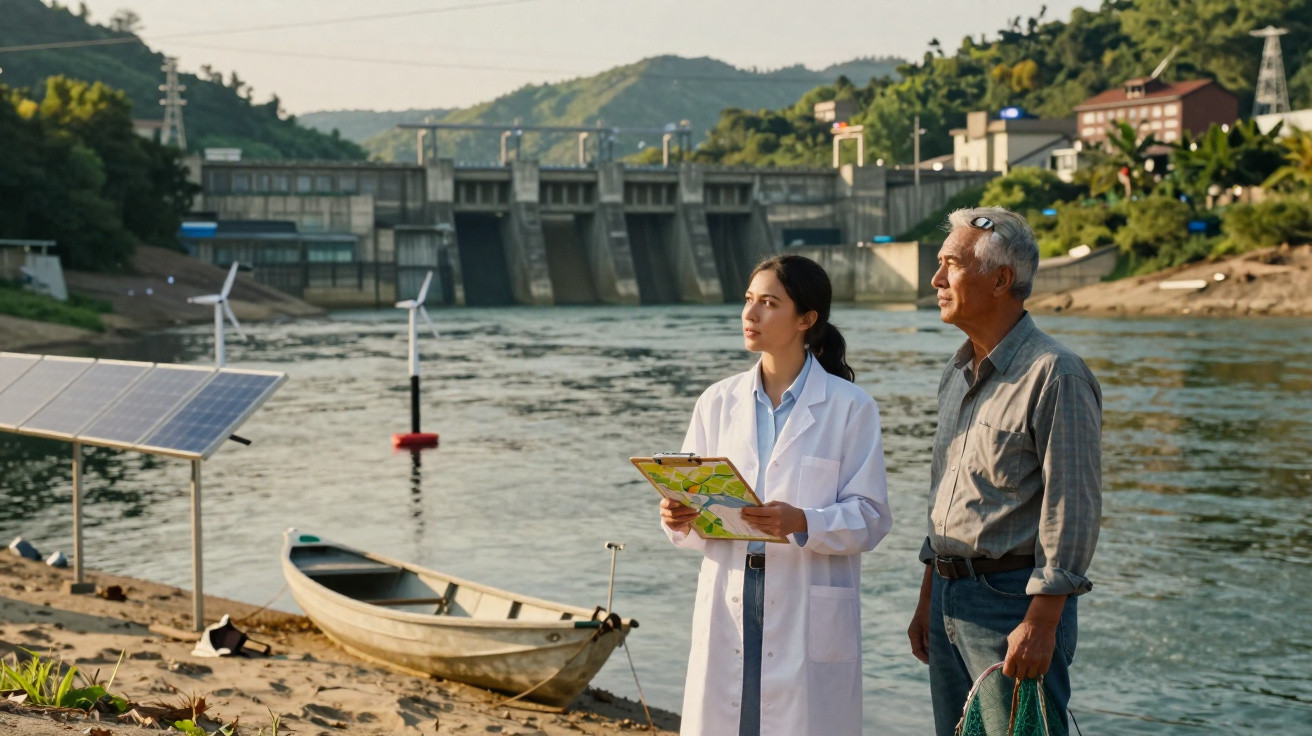
Considering full river systems also reveals further options. Floating solar panels can be installed on existing reservoirs, and wind turbines can use infrastructure that has already been developed for hydropower.
Other technologies produce energy from moving water without requiring substantial barriers. These options already operate in a number of regions.
They provide opportunities to raise energy output while limiting environmental harm.
Communities need a voice
Conventional dam developments use a top-down approach. Companies and governments take the decisions, and local communities often have limited influence.
The study recommends another model: shared decision-making in which affected communities are involved from the outset. Their views should help determine whether projects proceed and, if they do, how they are developed.
Such a shift could deliver fairer processes and better outcomes.
Energy users become producers
The concept of the prosumer introduces a further dimension. It refers to people who produce energy as well as consume it.
“Such a model would empower local and Indigenous communities to become both producers and consumers of their own energy,” said study co-author Sergio Villamayor Tomas.
“This approach can help to democratize the power system and ensure that those most affected by energy projects are also able to benefit from them, which generally has not been the case to date.”
This approach transfers greater power to communities, allowing them to benefit rather than simply carry the costs.
Renewable differs from sustainable
Hydropower is renewable because it depends on flowing water. But being renewable is not necessarily the same as being sustainable.
Sustainability requires environmental and social balance over the long term. A scheme may generate clean energy while still creating enduring damage.
The study stresses the importance of distinguishing between these concepts in public debate.
Solutions already exist
“However, with more strategic planning, horizontal governance and community-led solutions, our work demonstrates that the tools for a better path forward already exist,” said study co-author Maria Claudia Lopez.
“The question is not whether governments and investors will meet their energy needs, but [will they] do so without sacrificing the world’s vital ecosystems.
“The tools and frameworks are in place, and this article is one important contribution highlighting them and advancing ongoing discussions of the energy transition.”





Comments
No comments yet. Be the first to comment!
Leave a Comment