
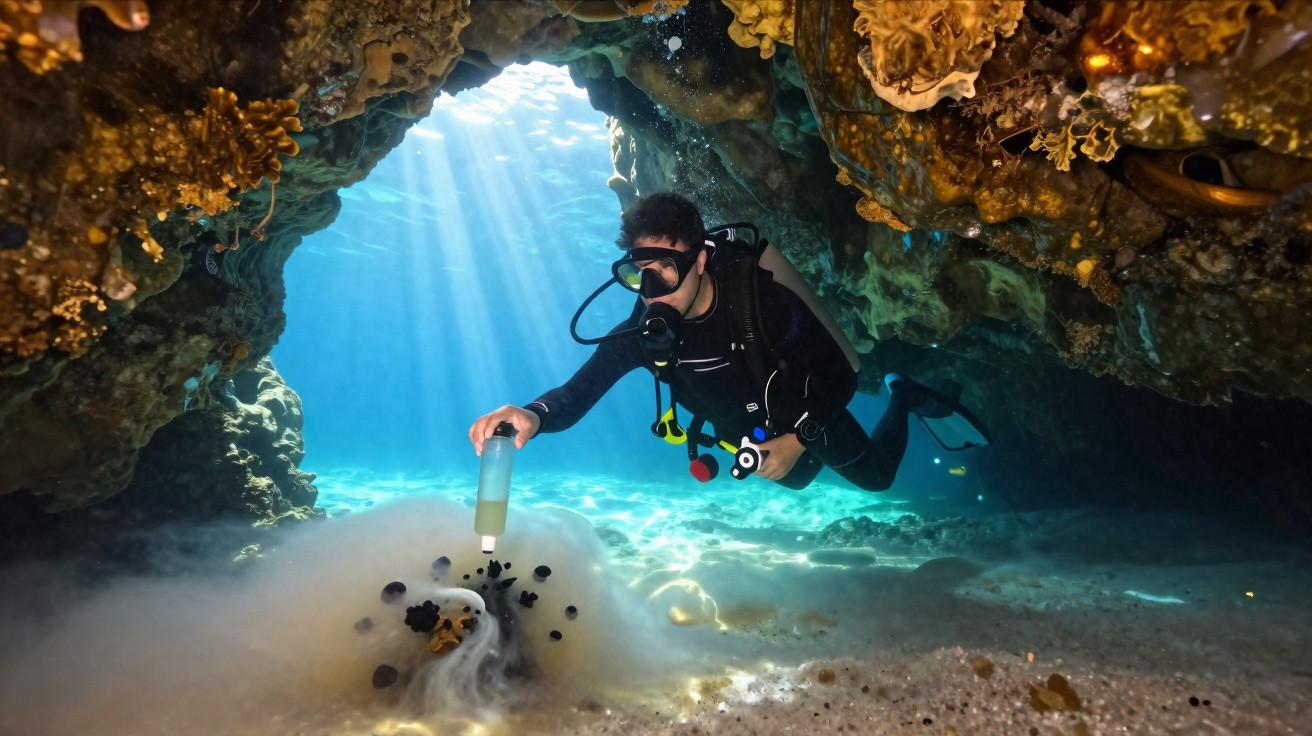
Within them, pale sheets of living film draw in methane seeping from rock and sediment, releasing something cleaner in return. A marine explorer I spoke to describes them as “filters the world forgot”, and the words have stayed with me. While heatwaves and algal blooms eat away at coastlines, these concealed chambers consume a gas we dread and transform it into life. Their work is hushed, gradual and almost unseen. That is both the wonder of it - and the caution.
The morning opens with a strip of light across the water and a rope dropping vertically into the blue. I watch the explorer fasten a sampler to her chest, inspect her gauges twice, then slip beneath the surface without a splash. We descend side by side, beyond the flickering boundary where fresh and salt water meet, into a gently lit chamber that absorbs every sound. Delicate white drapes trail from the ceiling, like marine cobwebs. My breath makes one sharp pop, then seems to disappear.
At a cloudy layer no larger than a bedsheet, she stops and gestures with two fingers. A cluster of floc drifts in a motion as slow as breathing. There is a faint sweetness in the water: wet limestone mixed with something living. I see no mouths or teeth, only a cloud that appears to take in bubbles without chewing. These microbes consume methane before it can escape.
The cave had an appetite.
Inside a cave’s breath
Remain motionless and the cave begins to reveal its rhythm. The halocline trembles like heat over a motorway, settles, and trembles once more. Methane rises through the rock and encounters oxygen carried in from the open sea, creating a slender living film precisely at the meeting point of those two worlds. It appears delicate, almost decorative.
A single diver’s fin can wipe out a week’s growth in moments, but the film slowly returns with the patience of a tide. I watch it thread across the walls, binding grains of sand and holding loose fragments of leaves and silt. What seems to be slime is actually a crowded city: cells erecting structures, feeding on an unsettled gas, and leaving the water slightly clearer behind them.
Here, methane is not a villain but food. Methanotrophs - microbes that eat methane - gather along the oxygen boundary, converting CH4 into energy, water and fresh cells. Their remnants gather into clumps, sink, and cease to travel. The quietest walls can be the busiest. Minute predators then arrive to feed on the methanotrophs, and a food web develops from a gas we have learned to fear.
From blue holes to the coast: the unseen clean-up crew
My thoughts kept returning to an anchialine cave system connected to a mangrove lagoon along a quiet section of coastline. Across three seasons, the explorer mapped it, lowering samplers on fishing line and retrieving them after storms as though collecting ornaments. In the laboratory, methane levels fell dramatically across the milky boundary when compared with water immediately beneath it. In certain bottles, almost all of the methane had disappeared.
She showed me a graph whose honesty was almost confrontational: high on one side and low on the other. The depth difference was two metres. It was the same cave and the same day, yet different layers gave the gas a different outcome. In lab tests, the cave’s interface removed nearly nine-tenths of the methane in water samples. That difference matters in places where groundwater reaches seagrass beds and reefs already struggling to survive.
Why should anyone walking along a beach take notice? Many coastlines rest on limestone riddled with caves, sumps and tiny openings. These routes form plumbing between inland farms, towns and the sea. When nutrients and methane travel through that system, caves can reduce the highest and most hazardous pulses. The microbes burn methane for fuel, while their biofilms work like lint filters, catching particles that might otherwise cloud nursery habitats. One unseen layer performs two tasks.
Field craft, not folklore
There is a method for reading a cave without disturbing it. Direct your torch at an angle rather than straight ahead, then look for fine dust lifting through the water like smoke - that marks the boundary. Use small frog kicks with bent knees and heels together, keeping your fins above your body line to avoid stirring the bottom. Think of the film as skin on warm milk: hurry, and it will tear.
Collecting samples requires the same choreography, only with additional equipment. Take a Niskin bottle or syringe sampler, open it gently and close it using two fingers rather than a clenched fist. Mark labels underwater instead of on the boat, as bottles can become indistinguishable when people are under pressure. Let’s be honest: nobody really does this every day. Rehearse on open-water lines until it becomes dull, then take that familiarity into the cave.
What should you avoid? Do not pursue the milky layer as if it owes you a photograph. Do not brace yourself against the ceiling, and if you stir up silt, do not rush for the exit - stop, kneel, breathe and allow the chamber to settle. Treat a cave like a lung, not a tunnel. The explorer said this while standing on wet sand, with water still dripping from her equipment:
“They don’t look like heroes, but they save us from our own leaks - quietly, molecule by molecule.”
Here is a short reminder worth keeping close:
- Watch for shimmers and milky veils: they mark the action line.
- Move slowly; write quickly: notes disappear sooner than silt settles.
- Keep first surveys shallow; depth reduces your choices.
- Leave bubbles only, never fingerprints on biology.
- If you disturb it, wait. The cave rewards patience.
A different view of the sea’s basement
Most of us have known the feeling of discovering that somewhere familiar contains more than we realised - a side road hiding a café, or a park where owls were present all along. Underwater caves offer the same surprise, only farther down and far wetter. They are not empty spaces. They are organs woven into the coastline, alive with cells that consume methane so bays can breathe. Once microbes reach that methane, it does not arrive at the surface in the same form.
There is a climate resonance in that. Methane traps substantial heat in the short term, and every pocket filtered below ground means one fewer opportunity for a surge. Nobody suggests that caves alone can halt warming or solve algal blooms. Yet a thousand small filters can make a difference, particularly where human life and the sea meet uneasily. This is a story of restraint: allowing quiet systems to complete their work before our heavy boots disrupt them.
I left with salt drying on my neck and thoughts of care. Care while diving, care in how land above caves is used, and care in the way we tell stories about faceless things. Microbes require very little: darkness, a little oxygen and a stream of methane to consume. In exchange, they clean. It feels like an almost old-fashioned arrangement, like a neighbour watering your plants without sending a message first.
| Key point | Detail | Why it matters to the reader |
|---|---|---|
| Methane-eating microbes thrive in cave interfaces | They occupy the point where oxygen meets methane and convert CH4 into biomass | Explains why these concealed layers work as natural filters |
| Blue holes and anchialine systems form coastal plumbing | Passages connect inland water with reefs, seagrass and lagoons | Shows how cave health influences coastal clarity and resilience |
| Gentle field craft protects the “living film” | Slow movement, angled light, clean sampling and considered exits | Offers practical actions anyone can understand - and respect - even from shore |
FAQ:
- What exactly are methane-eating microbes in caves? They are methanotrophs: bacteria that use methane as an energy source. They gather where oxygen-rich seawater meets methane-rich groundwater and are often visible as a milky or shimmering layer.
- Do underwater caves really reduce greenhouse gas emissions? They can greatly reduce methane travelling through coastal groundwater by oxidising it before it enters open water. As a result, less methane is available to escape into the atmosphere from springs, seeps or mixing zones.
- Is it safe to dive in these caves to see the layers? Cave diving is specialist work and dangerous without training. Teams rely on strict procedures, redundancy and mapping; the safest support is to learn through images, join guided science programmes or assist with surface logistics.
- How does this affect everyday coastal life? Cleaner groundwater inflows help sustain clearer lagoons, healthier seagrass and more stable nursery habitats. Fewer surges of nutrients and methane mean fewer stressful events for people who fish, swim and work along the coast.
- Can we protect these microbial filters? Yes - by cutting land-based pollution, safeguarding sinkholes and springs from development, and reducing sediment disturbance in caves. Small policy measures at the surface protect the quiet work taking place below.




Comments
No comments yet. Be the first to comment!
Leave a Comment