
The Levant in the Middle East has long been understood as a crossroads for early humans and Neanderthals, including groups native to the area and others travelling between different regions.
The numerous skeletal remains recovered there display considerable morphological variation, yet the evidence for social and cultural behaviour is notably consistent.
Levantine sites provide proof of deliberate burials, grave goods placed with the dead, and ochre used at burial locations.
This record of social and cultural conduct predates comparable evidence elsewhere in the world by tens of thousands of years.
In a recent study, researchers examined unprecedented discoveries from Tinshemet Cave in Israel to investigate the relationship between Neanderthals and Homo sapiens during the mid-Middle Palaeolithic.
The site contains remains from both hominin species, which appear to have shared practices, technology and funeral rites.
Neanderthals, humans, and Tinshemet Cave
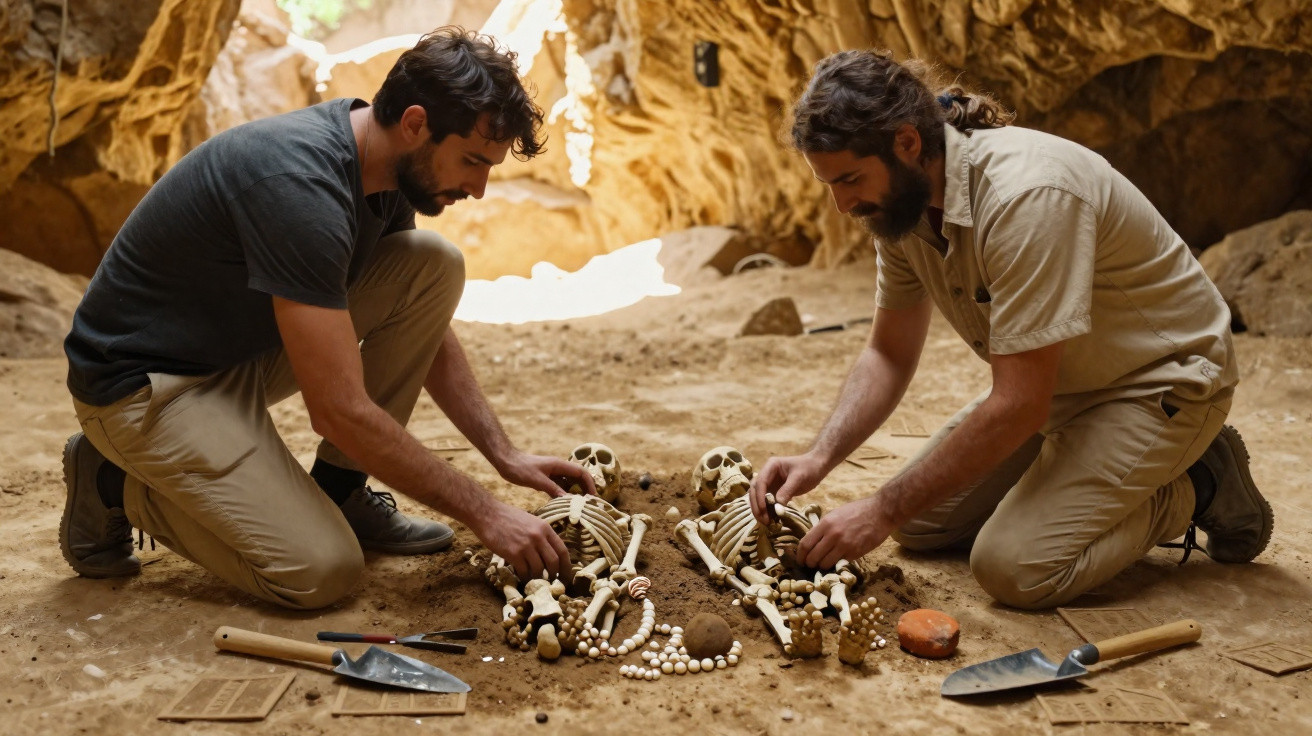
Tinshemet Cave has emerged as an archaeological and anthropological treasure trove, yielding skeletons - several of them nearly complete - alongside burial sites and objects associated with those graves.
These represent the first newly investigated Middle Palaeolithic (MP) human burials in 50 years.
Evidence from Tinshemet Cave suggests these early humans were more than neighbouring groups: they actively exchanged knowledge and shaped one another’s survival methods, tool production and cultures.
Comparisons with findings from other Levantine locations revealed similar tools, the same positioning of skeletons in graves, objects included for use in the afterlife, and ochre fragments spread throughout the deposits.
Although several hominin types were present, the evidence suggests they all followed shared cultural and social customs.
The relationship between early humans and Neanderthals was therefore evidently more intricate than had first been believed.
Humans and Neanderthals shared culture
Excavations of deposits at Tinshemet Cave have continued since 2017. The work is led by Professor Yossi Zaidner of the Hebrew University of Jerusalem, Professor Israel Hershkovitz of Tel Aviv University, and Dr Marion Prévost of the Hebrew University of Jerusalem.
The researchers’ central aim has been to determine the nature of the connection between Homo sapiens and Neanderthals in this part of the region during the mid-Middle Palaeolithic.
Did the two groups compete for resources, live peacefully alongside one another, or collaborate?
For the study, the team combined information from four key areas: stone-tool manufacture, hunting strategies, symbolic behaviour and social complexity.
This combined analysis suggested that distinct human groups - including Neanderthals, pre-Neanderthals and Homo sapiens - which occupied the Levant at different times, participated in substantial interactions.
Such meetings allowed knowledge and skills to be exchanged, ultimately creating cultural mixing among these populations.
Burial rituals shared
A cluster of human burials discovered at Tinshemet Cave also prompts compelling questions about the site’s place in MP society.
Might the cave have served as a designated burial place, or even as a cemetery?
Stone tools, animal bones and chunks of ochre placed inside burial pits point to early beliefs in an afterlife, suggesting shared social rites and close community ties.
Importance of Tinshemet Cave
The Tinshemet Cave discoveries provide a view of a dynamic era of prehistoric interaction, indicating that early humans and Neanderthals not only lived alongside each other but also affected each other’s ways of life.
Professor Zaidner characterises Israel as a “melting pot” in which different human groups encountered one another, interacted and evolved together.
“Our data show that human connections and population interactions have been fundamental in driving cultural and technological innovations throughout history,” he explained.
Dr Prévost emphasised the region’s exceptional geographical location at the meeting point of human dispersals.
“During the mid-MP, climatic improvements increased the region’s carrying capacity, leading to demographic expansion and intensified contact between different Homo taxa,” he said.
Humans and Neanderthals – socially complex
This demographic change probably enabled the social exchanges behind the shared technological and cultural developments visible in the archaeological record.
Professor Hershkovitz noted that the interconnected lifestyles of the Levant’s different human groups indicate profound relationships and common strategies for adaptation.
“These findings paint a picture of dynamic interactions shaped by both cooperation and competition.”
Finds from Tinshemet Cave strengthen the view that prehistoric human groups were not isolated, but instead took part in continuous exchanges that influenced their learning, survival, culture and technological development.
More study at Tinshemet Cave
The evidence from Tinshemet Cave offers an intriguing insight into the social organisation, symbolic activities and daily lives of early human populations.
Through uncovering shared burial customs, technology transfer and possible cultural blending between Neanderthals and Homo sapiens, researchers are reshaping the history of prehistoric coexistence.
As excavation work continues, future finds could expose additional burial areas, artefacts or symbolic inscriptions that clarify the nature of interspecies interactions in this region.
The complete study was published in the journal Nature Human Behaviour.





Comments
No comments yet. Be the first to comment!
Leave a Comment